Tarot, jeu et magie (catalogue de l'exposition de la Bibliothèque nationale)
Thierry Depaulis · 1984
See the book
The 36-card deck attributed to Mademoiselle Lenormand, and how to read its combinations.
Library figures as of November 9, 2026.
The Lenormand is a deck of 36 cards attributed to Mademoiselle Lenormand. The books on the shelf fall into three groups: manuals for learning to read the cards and their combinations, histories of the deck that separate the woman from the legend, and old cartomancy texts, including those of the sibyl herself and of Etteilla.
The practice is read mostly in English and German, with one guide in Portuguese. French leans toward history: Thierry Depaulis traces that of divinatory cards, and several texts from 1770 to 1854 are in the public domain. On the origin of the deck, books point to Hechtel's Das Spiel der Hoffnung, around 1799, a deck of 36 cards with figures whose structure the Petit Lenormand takes up.
If you want to learn to read, start with a recent manual. If you want to know where the deck comes from, open a history first. The two sometimes meet: Katz and Goodwin give the order of the cards according to Hechtel in their method.
Thierry Depaulis · 1984
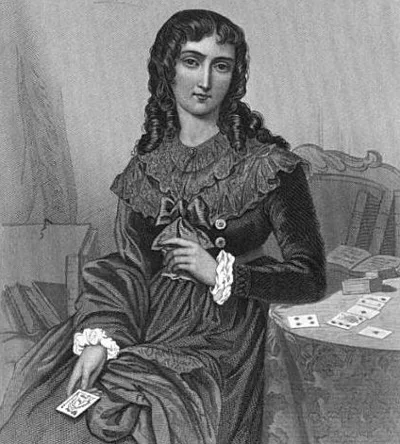
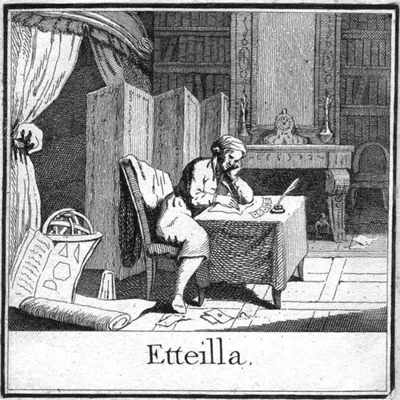
See the bookThe book of the Bibliothèque nationale exhibition, by Thierry Depaulis in 1984, gives the French history of divinatory cards and of Etteilla. It is the only historical framework in French on the shelf.
Caitlín Matthews · 2003
See the bookIn 2003 Caitlín Matthews presents the sibyl, her milieu, then a reading of the 36 cards in the European style. History and practice sit in the same volume, and English-speaking practitioners refer to it.
Marcus Katz and Tali Goodwin · 2013
See the bookA complete manual by Marcus Katz and Tali Goodwin, 2013. The meaning of the 36 cards, line and grid spreads, the order of the cards according to Hechtel. To take for learning step by step.
Rana George · 2018
See the bookIn 2018 Rana George wrote a practitioner's manual on the order of the cards and their combinations. To read after Katz and Goodwin, to set another practice against theirs.
Decker, Depaulis and Dummett · 1996
See the bookIn 1996 Decker, Depaulis and Dummett treat Mademoiselle Lenormand and the link between the Petit Lenormand and the Jeu de l'Espérance. They show that she read with ordinary cards. The reference book on the history.
Iris Treppner · 2010
See the bookIn 2010 Iris Treppner offers, in German, a manual on the symbolism of the 36 cards and the spreads, which her publisher presents as a standard.
Odete Lopes Mazza · 2022
See the bookIn 2022 Odete Lopes Mazza covers the 36 cards in Portuguese, with a chapter on the origins.
To begin
To go deeper
Going further
All 187 Books 164Free 17Articles 6
Refinar
Chantal Frelaut Carole Sédillot
19,90 € at Cultura
See the bookJulian Van Bur Esméralda Bernard
9,00 € at Cultura
See the bookJean-Didier · 1999
22,30 € at Cultura
See the book16,99 € at Cultura
See the bookAlexander Ray
22,90 € at Cultura
See the bookToni Savory
26,00 € at Cultura
See the bookKatrina Hill Kendra Hurteau
45,23 € at Cultura
See the bookRenata Lechner
22,90 € at Cultura
See the book13,00 € at Cultura
See the bookJean-Baptiste Alliette · 1770
DownloadMarie-Anne Adélaïde Lenormand · 1826
DownloadMarie-Anne Adélaïde Lenormand · 1819
DownloadMarie-Anne Adélaïde Lenormand · 1817
DownloadMarie-Anne Adélaïde Lenormand · 1814
DownloadJean-Baptiste Alliette · 1783
DownloadMarie-Anne Adélaïde Lenormand ; traducteur anonyme de 1848, édition de 1895 · 1895
DownloadOdete Lopes Mazza · 2022
See the bookMichael Dummett and Ronald Decker · 2002
See the bookDecker, Depaulis and Dummett · 1996
See the bookHeike Maria Weichsel · 2017
See the bookChris Delor André Stern · 1999
See the bookAlexandre Musruck · 2018
See the bookHeike Maria Weichsel · 2017
See the bookPetra Shakira Geisel Angelina Schulze · 2020
See the bookHeike Maria Weichsel · 2017
See the bookChristiane Neumann · 2025
See the bookAmina Mayer · 2020
See the bookSteliana Pujolras · 2015
See the bookCorinne Morel · 2022
See the bookCorinne Morel · 1996
See the bookHarald Jösten · 2017
See the bookHarald Jösten · 2018
See the bookJohann Kaspar Hechtel · 1799
See the bookJohannes Fiebig Alexander Glück · 2017
See the bookS. ROE Buchholzer Kirsten Buchholzer · 2025
See the bookAngelina Schulze · 2019
See the bookKathleen Bergmann · 2022
See the bookKathleen Bergmann · 2016
See the bookAndrea Rosenthal · 2021
See the bookMichaela Truschzinski · 2022
See the bookAnne L. Biwer
See the bookDaniela Mattes · 2018
See the bookIris Treppner · 2010
See the bookKathleen Bergmann · 2021
See the bookKathleen Bergmann · 2021
See the bookErika Robinson · 2025
See the bookChristine Schlüter and Katrin Rosali Giza · 2009
See the bookPetra Shakira Geisel Angelina Schulze · 2020
See the bookThe earliest book by each author in this section, dated by the edition offered here.
Two schools of reading are distinguished by language. On the English-speaking side, Caitlín Matthews, Marcus Katz and Tali Goodwin, then Rana George offer complete methods. The German manuals are numerous: Iris Treppner, Kathleen Bergmann, Anne L. Biwer, Vaylinor, who draws on the Austrian Piatnik no. 1941 deck, Christine Schlüter with Katrin Rosali Giza, and Alexandra Lara Weng in five volumes. The historians answer them. Detlef Hoffmann and Erika Kroppenstedt brought to light in 1972 the link between the Petit Lenormand and the German deck of 1799, which Decker, Depaulis and Dummett take up in 1996. Hoffmann and Kroppenstedt also wrote, in 1997, a work on divinatory games and oracle books. Dummett and Decker then place occultist cartomancy from 1870 to 1970. Among the older authors, Etteilla published from 1770 to 1783, well before the Petit Lenormand, and Hechtel published around 1799 the deck from which it draws.
In 1814 Mademoiselle Lenormand tells of her practice as a seer in Paris, her clients and her methods. It is the only direct word of the sibyl, useful for separating the woman from the deck that bears her name.
The first printed French cartomancy manual, published by Etteilla in 1770, on the piquet deck of 32 cards. It precedes the Petit Lenormand by some thirty years.
The second expanded edition of 1773, with the meaning of each card, spreads and reading rules.
In 1854 Paul Boiteau d'Ambly tells the history of playing cards and cartomancy in France, with mentions of Mademoiselle Lenormand.
The English version, in the edition of 1895, of the Memoirs attributed to Lenormand on Josephine. An imperial legend that fed the Lenormand brand.
To learn to read, take Learning Lenormand by Katz and Goodwin, in English. For the history, Matthews or Decker, Depaulis and Dummett.
Yes, public-domain works. They include texts by Mademoiselle Lenormand herself, Etteilla's books from 1770 to 1783 and Boiteau d'Ambly's history of 1854.
According to Decker, Depaulis and Dummett, she read with ordinary cards. The Petit Lenormand is better linked to Hechtel's Jeu de l'Espérance, around 1799.
Iris Treppner presents her Praxisbuch as a standard. Kathleen Bergmann offers a course with examples, and Alexandra Lara Weng a five-volume course for beginners.
A game of 36 cards with figures and a board by Johann Kaspar Hechtel, around 1799. The structure of the Petit Lenormand comes from it, and a rule booklet has been translated into English.
Guide updated on 7 novembre 2026