
The Essentials of Vedic Astrology
Komilla Sutton · 1999
See the book
The astrology of India. It is calculated on the sidereal zodiac and divides life into planetary periods.
Library figures as of November 9, 2026.
Jyotish is the astrology of India. It is calculated on the sidereal zodiac and divides life into planetary periods, the dashas. The books on this shelf follow three lines: modern manuals for learning, translations of the basic texts such as the Brihat Parasara Hora Sastra, and commentaries on the Jaimini system.
No title is in French. Almost everything is in English, with a few Sanskrit editions and a German scholarly work of 1899. B. V. Raman is the most present author: his manuals and studies run from 1935 to 1959, and the journal he edited, The Astrological Magazine, appeared from 1895 to 1991.
Your starting point depends on what you are looking for. As a beginner, take a modern manual. If you want to understand prediction, move on to Raman. To read the tradition at its source, open Santhanam's translations. The free texts go further back: Varahamihira's Brihat Jataka, the Surya Siddhanta and the works on the Indian calendar, which explain where the calculations come from.
Komilla Sutton · 1999
See the bookKomilla Sutton's modern manual, published in 1999, to take if you have read nothing yet on jyotish.
Dennis Svoboda and Gabriela de Fouw · 1996
See the bookIn 1996 Dennis Svoboda and Gabriela de Fouw wrote a modern manual that links jyotish with psychology. Choose it if you come from that side.
B. V. Raman · 1935
See the bookPublished in 1935, B. V. Raman's manual is a reference among modern works. It is the next step after a first book.
B. V. Raman · 1938
See the bookIn 1938 Raman treats here prediction through the dashas and gochara, the transit of the planets. To read once the basics are in place.
R. Santhanam · 1984
See the bookThe basic text of the tradition, in two volumes, in R. Santhanam's reference translation, published in 1984. For those who want to read the doctrine at its source.
R. Santhanam · 1990
See the bookIn 1990 R. Santhanam gives an annotated edition of the Brihat Jataka. It reads beside the free translation of 1905, which is older.
G. S. Kapoor · 1988
See the bookIn 1988 G. S. Kapoor comments on the Jaimini system sign by sign, with the arudha and the karakamsha. The choice for digging into this system.
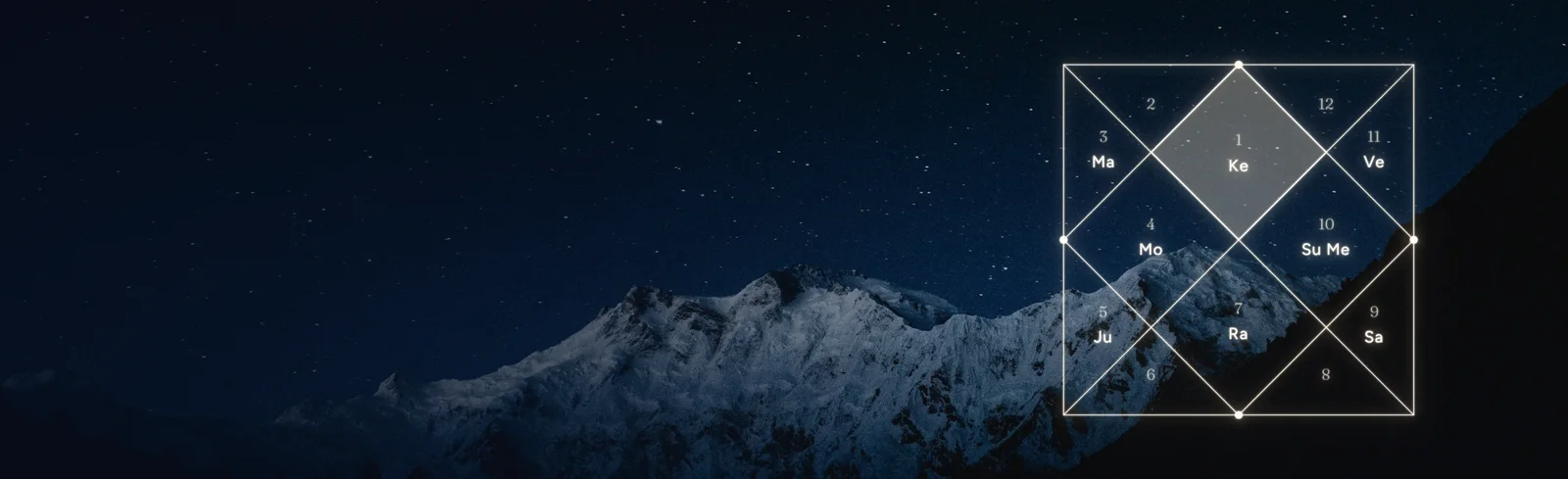
Rosmaryn Vedic
Your sidereal ascendant, your planets in the houses, your nakshatra and your life period, calculated for free.
Calculate my Vedic chartEverything revolves around B. V. Raman: a manual in 1935, a book on prediction in 1938, the Varshaphal in 1941 and studies on Jaimini in 1959. R. Santhanam translates the Brihat Parasara Hora Sastra in 1984, then the Brihat Jataka in 1990. For Jaimini, three paths are open to you: G. S. Kapoor's sign-by-sign commentary, B. Suryanarain Rao's translation published in 1936, and Rangacharya Iranganti's applications in 1990. Solar returns come through Neelakantha and his Tajika Neelakanthi, with Raman's Varshaphal as an echo. V. Subrahmanya Sastri published in 1949 the Horasara of Prithuyasas, and P. S. Sastri linked houses to diseases in 1950. The recent manuals are those of Komilla Sutton, Dennis Svoboda and Gabriela de Fouw. Among free works, N. Chidambaram Aiyar translates the Brihat Jataka, Ebenezer Burgess the Surya Siddhanta, Hendrik Kern the Brihat Sanhita, and Georg Thibaut studies the Greek borrowings of Indian astrology.
The founding treatise of jataka, with the signs, planets, yogas and dashas, in N. Chidambaram Aiyar's translation of 1905.
In 1898 B. Suryanarain Row translates this jataka treatise with the Devanagari text and notes.
Tithi, nakshatra, positions and calendar: Vedic calculation rests on this text, translated by Burgess in 1860.
In 1896 Sewell and Dikshit explain the panchanga, with the tables of tithi, nakshatra, yoga, karana and vara.
In 1865 Hendrik Kern edits in Sanskrit Varahamihira's Brihat Sanhita, on mundane astrology and omens, which completes the Brihat Jataka.
In 1899 Georg Thibaut studies, in German, the sources of Indian astrology and its Greek borrowings.
The monthly of Indian astrology that B. V. Raman edited in Bangalore, from 1895 to 1991.
With a modern manual: The Essentials of Vedic Astrology by Komilla Sutton or A Manual of Hindu Astrology by B. V. Raman. Keep the basic texts for later.
Not on Library. The manuals and translations are in English, with a few Sanskrit editions and a German scholarly work.
Yes, several are in the public domain: Varahamihira's Brihat Jataka in English translation, the Surya Siddhanta translated by Burgess in 1860 and The Indian Calendar published in 1896.
Raman writes modern manuals, geared to practice and prediction. Santhanam translates the ancient texts, including the Brihat Parasara Hora Sastra, for those who want to read the doctrine at its source.
G. S. Kapoor's commentary, published in 1988, follows the signs one by one. B. Suryanarain Rao's translation dates from 1936 and remains the only old one found, and in 1990 Rangacharya Iranganti shows how to apply the Jaimini systems.
Guide updated on 7 novembre 2026


